
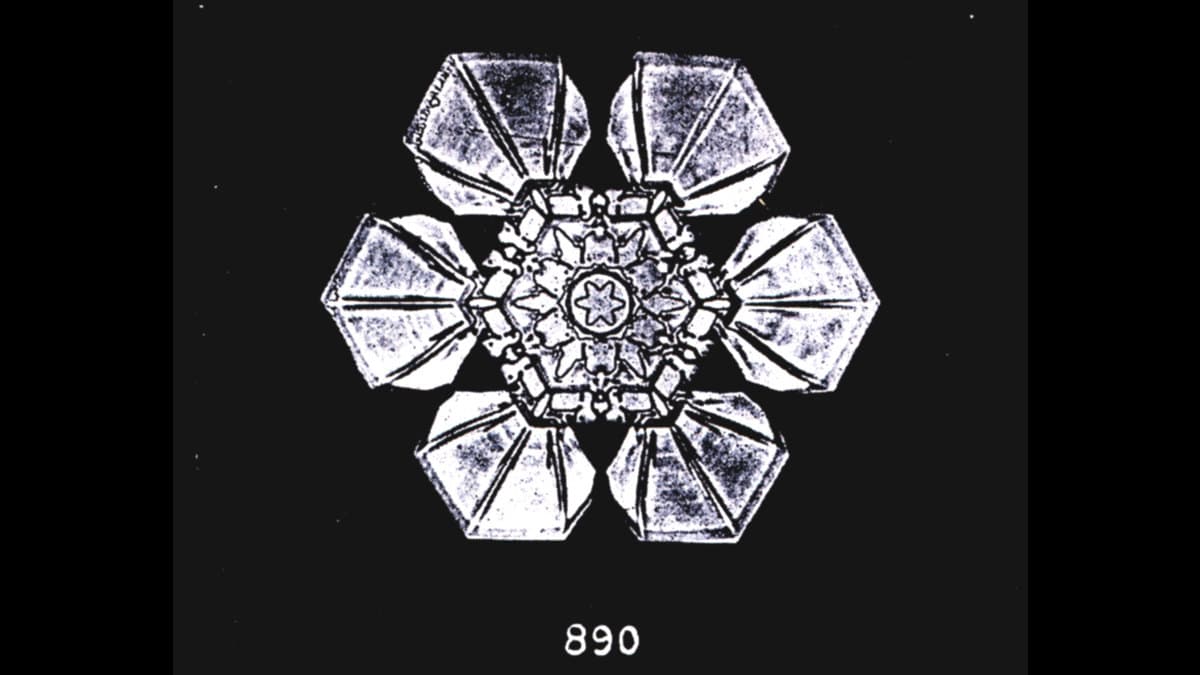
A carefully photographed snow crystal can look like a miniature piece of geometry. Its branches may repeat around the center, often producing a six-sided pattern. That organization begins at a scale much smaller than the branches themselves. [1]
Water molecules set the pattern
In the ordinary ice that forms in snow clouds, water molecules arrange into a crystal structure associated with sixfold symmetry. A small growing crystal can form a hexagonal prism. Its underlying arrangement helps determine the directions in which later growth develops. [1]
The cloud writes the details
Temperature and moisture influence how a crystal grows. Some conditions encourage flatter facets; others encourage branching. As the crystal moves through a cloud, it encounters different conditions, changing the growth of its edges and tips. [1]
Not every flake is a star
Snow includes more than the intricate crystals usually shown in photographs. Ice particles can have forms such as plates, columns, or needles. Falling crystals can also collect together, making larger snowflakes from several individual pieces. [2]
Conditions on the way down affect what reaches the ground. Snow may be dry and powdery or wetter and more easily packed. A handful of snow therefore does not necessarily contain a collection of untouched, identical-looking stars. [2]
A record of a journey
Compare a close-up photograph with a simple snowflake drawing. Look for the broad repeating pattern first, then inspect the smaller details. This separates a convenient symbol for snow from the structure of a particular crystal.
A snow crystal combines a consistent microscopic building pattern with a changing environment. Its broad symmetry reflects the structure of ice; its finer details reflect how it grew. The useful question is not only what shape a flake has, but what happened as that shape formed. [1] [2]
Sources and image credit
1. NOAA NESDIS: How Do Snowflakes Form?
2. National Snow and Ice Data Center: Science of Snow
Cover: Wilson Bentley (1902), NOAA historical collection. Public domain. Resized and cropped or letterboxed to a 16:9 cover. Image source · Usage / license