
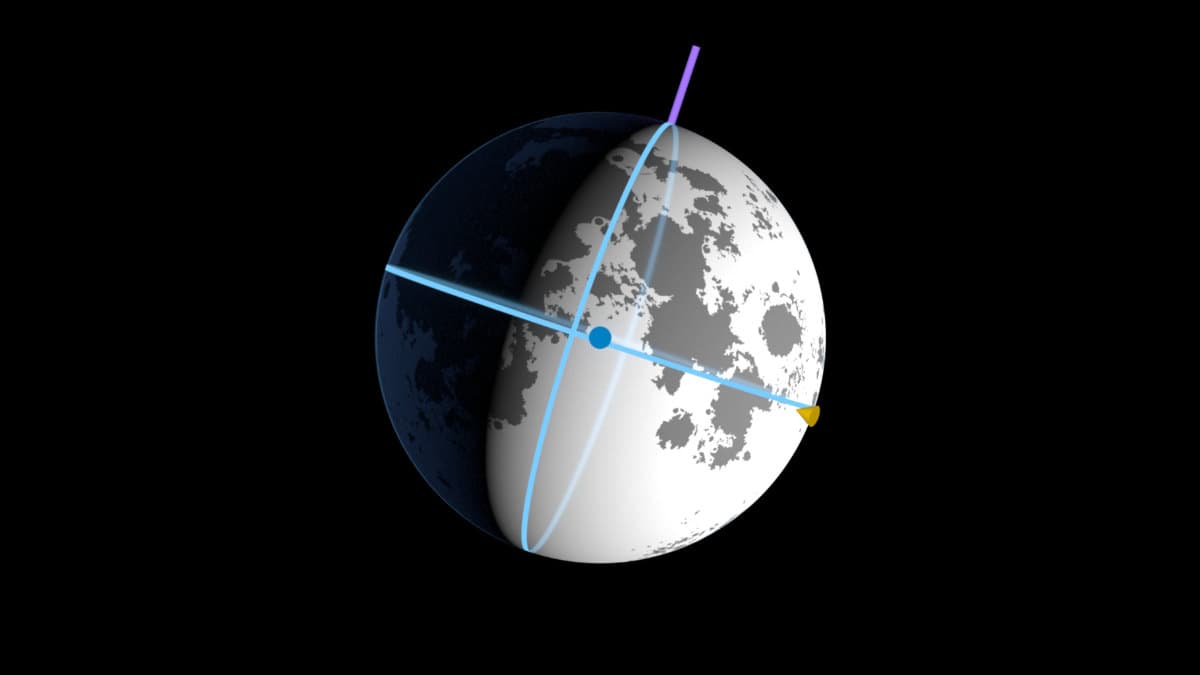
One night the Moon looks like a thin curved sliver. Later it appears half bright, and eventually it becomes a nearly full circle. These changing appearances are phases, not changes to the Moon’s actual shape. [1]
A world lit by the Sun
Moonlight is sunlight reflected from the lunar surface. Normally, the Sun lights about half the Moon, just as it lights half of Earth. The important question is how much of that illuminated half faces Earth at a particular point in the Moon’s orbit. [1]
The view changes around the orbit
As the Moon travels around Earth, the angle between the Sun, Earth, and Moon changes. At new moon, most of the illuminated half faces away from Earth. Near full moon, most of that half faces toward us. Between them, a crescent, quarter, or gibbous Moon reveals an intermediate view. [1]
A simple observation journal can separate shape from appearance. Draw the bright portion on several clear evenings and record the date and time. Compare the sketches rather than trying to remember one isolated view. The question to investigate is how the visible pattern changes from one observation to the next.
Earth’s shadow is a different event
Ordinary phases are not caused by Earth blocking sunlight. That happens during a lunar eclipse, when Earth lies between the Sun and Moon and the Moon passes through Earth’s shadow. [2]
Lunar eclipses occur near full moon, but not every full moon brings one. The Moon’s orbit is tilted relative to Earth’s path around the Sun, so the three bodies usually do not line up precisely enough. [2]
A shape versus a viewpoint
The distinction is useful far beyond astronomy: an object can stay the same while its appearance changes. For the Moon, the changing ingredients are illumination and viewing angle. Its round world remains there, even when much of the side facing Earth is dark. [1] [2]
Sources and image credit
2. NASA Science: Eclipses and the Moon
Cover: NASA Scientific Visualization Studio. Public domain. Resized and cropped or letterboxed to a 16:9 cover. Image source · Usage / license