The 53 competencies set for Grade 8 Math, and every one has lessons behind it.
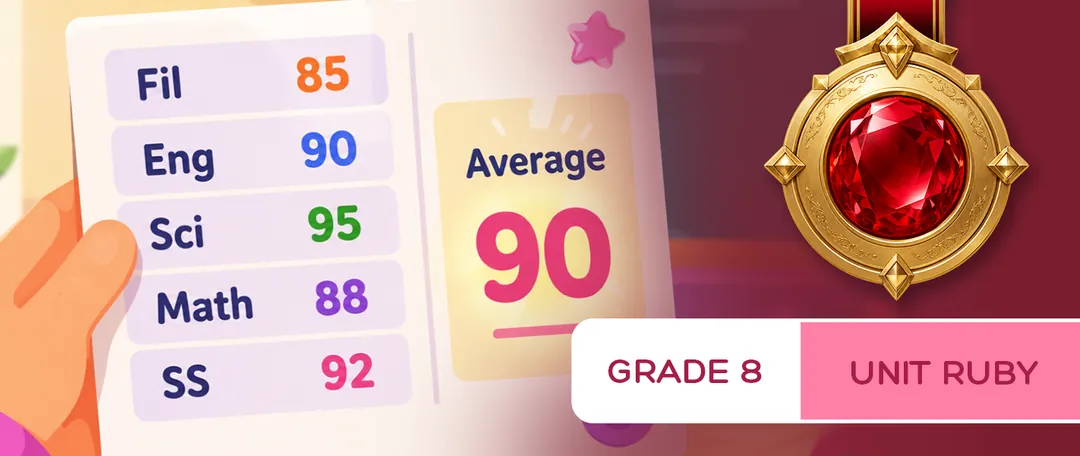
Measures of Central Tendency
2 competencies
Determine measures of central tendency of ungrouped data.
Draw conclusions from statistical data using the measures of central tendency.
Algebraic Expressions and Polynomials
7 competencies
Model real-life situations using algebraic expressions.
Add and subtract simple monomials.
Multiply and divide simple monomials, leading to the derivation of the laws of exponents.
Multiply simple monomials and binomials with simple binomials and multinomials, using the distributive property with various techniques and models.
Use special product patterns to multiply binomials.
Completely factor different types of polynomials, including polynomials with common monomial factor, difference of two squares, quadratic trinomials, and perfect square trinomials.
Solve problems involving special products and factors of polynomials.
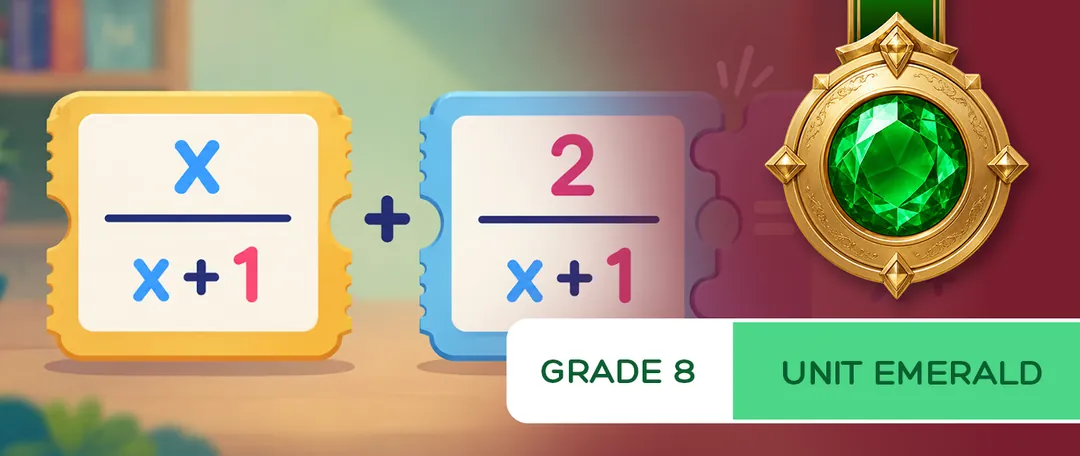
Rational Algebraic Expressions and Equations
3 competencies
Simplify rational algebraic expressions.
Perform operations on rational algebraic expressions.
Solve problems involving simple rational algebraic equations using cross-multiplication.
Patterns and Sequences
1 competency
Formulate the rule for finding the next term in a sequence by looking for patterns.
The Cartesian Coordinate Plane
4 competencies
Illustrate and describe the Cartesian coordinate plane.
Plot points on the Cartesian coordinate plane and determine the coordinates of a point on the plane.
Solve problems involving distance between two points on the Cartesian coordinate plane.
Solve problems involving midpoint of a line segment on the Cartesian coordinate plane.
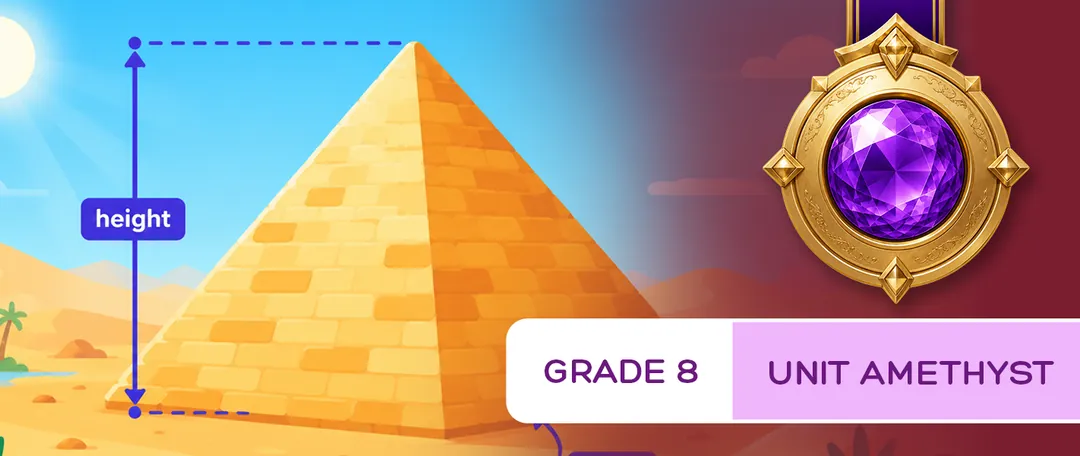
Volumes of Pyramids, Cones, and Spheres
6 competencies
Explore inductively the volume of pyramids other than square and rectangular pyramids.
Find the volume of pyramids other than square and rectangular pyramids.
Explore inductively the volumes of cones and spheres, leading to their formulas.
Find the volumes of cones and spheres.
Solve problems involving the volume of pyramids.
Solve problems involving the volume of cones and spheres.
Triangle Relationships
2 competencies
Apply the Pythagorean Theorem in finding the missing side of a right triangle, and its converse in classifying triangles.
Apply the triangle inequality theorems to establish results for angles and sides in triangles.
Financial Mathematics
1 competency
Solve financial problems involving earning money, profit and loss, buying amounts of products that represent the best value or best buys, and buying on terms or installment plans.
Linear Equations and Inequalities in One Variable
5 competencies
Solve linear equations in one variable.
Solve problems involving linear equations in one variable, including number problems, geometry problems, and money problems.
Solve linear inequalities in one variable.
Graph on a number line the solution of linear inequalities in one variable.
Solve problems involving linear inequalities in one variable.
Linear Equations in Two Variables
4 competencies
Describe a linear equation in two variables and express its solution using ordered pairs.
Define and determine the slope and intercepts of a line.
Find the equation of a line given two points, the slope and a point, the slope and y-intercept, and the x- and y-intercepts.
Sketch the graph of a linear equation given any two points on the line, the x- and y-intercepts, or the slope and a point on the line.
Systems of Linear Equations
5 competencies
Define and illustrate a system of linear equations in two variables.
Solve a system of linear equations with integer solutions by graphing.
Classify the types of systems of linear equations based on the number of solutions.
Solve algebraically a system of linear equations in two variables.
Solve problems involving systems of linear equations in two variables.
Linear Inequalities in Two Variables
1 competency
Recognize and solve problems involving linear inequalities in two variables.
Measures of Variability
3 competencies
Calculate range for ungrouped data.
Draw conclusions from statistical data using measures of variability.
Calculate mean deviation and standard deviation for ungrouped data.
Interpreting Statistical Graphs
2 competencies
Investigate, interpret, and analyze graphs from primary data, such as examination scores.
Investigate, interpret, and analyze graphs from secondary data.
Probability and Counting
7 competencies
Differentiate theoretical from experimental probability by conducting an experiment or investigation.
Describe the sample space of an experiment.
Use the Fundamental Counting Principle to determine the number of possible outcomes of an experiment.
Calculate the theoretical probability of a single event by listing all possible outcomes.
Describe probability as a measure of the chance of an event occurring.
Calculate the probability of simple combined events by listing, or by possibility diagrams or tree diagrams.
Solve problems involving experimental probability and/or theoretical probability using the Fundamental Counting Principle.