The 58 competencies set for Grade 2 Math, and every one has lessons behind it.
Shapes, Lines, and Composite Figures
4 competencies
Represent and describe circles, half circles and quarter circles.
Compose composite figures made up of squares, rectangles, triangles, circles, half circles, and quarter circles, using cut-outs.
Decompose composite figures made up of squares, rectangles, triangles, circles, half circles, and quarter circles, using cut-outs and square grids.
Identify and explain the difference between straight and curved lines, and flat and curved surfaces of 3-dimensional objects.
Slides of Shapes
1 competency
Describe and draw the effect of a one-direction multi-step slide, or translation, in basic shapes and figures.
Numbers to 1,000
6 competencies
Count up to 1,000.
Read and write numerals up to 1,000.
Recognize and represent numbers up to 1,000 using a variety of concrete and pictorial models, and numerals.
Count by 2s, 5s, 10s, 20s, 50s, and 100s, not beyond 1,000.
Order numbers up to 1,000 from smallest to largest, and vice versa.
Describe the position of objects using ordinal numbers up to 20th.
Place Value
3 competencies
Determine the place value of a digit in a 3-digit number.
Determine the value of a digit.
Determine the digit of a number, given its place value.
Addition to 1,000
5 competencies
Illustrate addition of 2-digit and 1-digit numbers as “counting up” on the number line.
Add numbers with sums up to 1,000 in expanded form.
Add numbers with sums up to 1,000, with or without regrouping.
Illustrate and apply the following properties of addition using sums up to 1,000: the sum of zero and any number is equal to the number; changing the order of the addends does not change the sum; changing the grouping of the addends does not change the sum.
Solve problems involving addition with sums up to ₱1,000, including problems involving money, with and without regrouping.
Philippine Money
2 competencies
Determine and write the value of a number of bills, or a number of coins, or a combination of bills and coins up to ₱1,000, including centavo coins only, peso coins only, peso bills only, and combined peso coins and peso bills.
Compare the values of different denominations of peso coins and bills up to ₱1,000.
Length and Distance
6 competencies
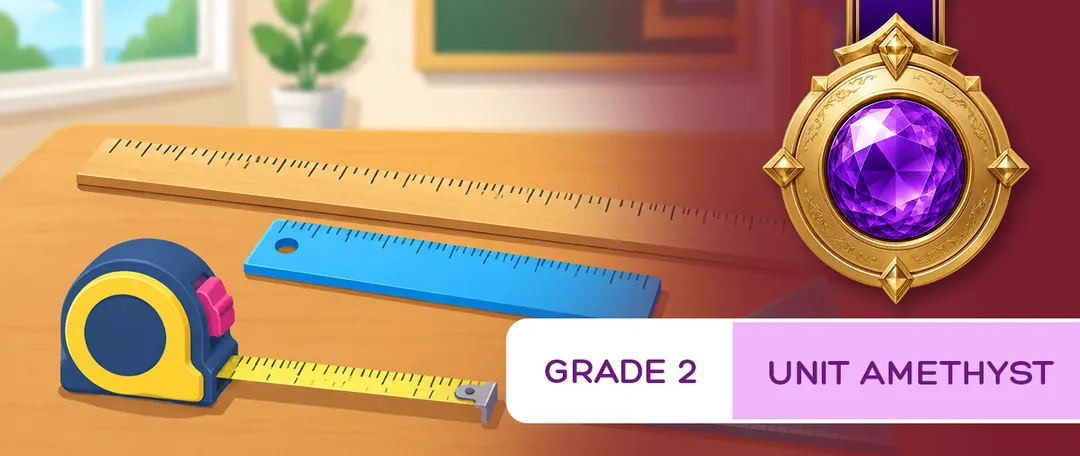
Measure lengths of objects in meters or centimeters using appropriate measuring tools.
Compare lengths of objects.
Measure distance in meters using appropriate measuring tools.
Identify and use the appropriate unit, meter or centimeter, to measure the length of an object and the distance between two locations.
Estimate length using meters or centimeters, and distance using meters.
Solve problems involving length and distance.
Subtraction to 1,000
5 competencies
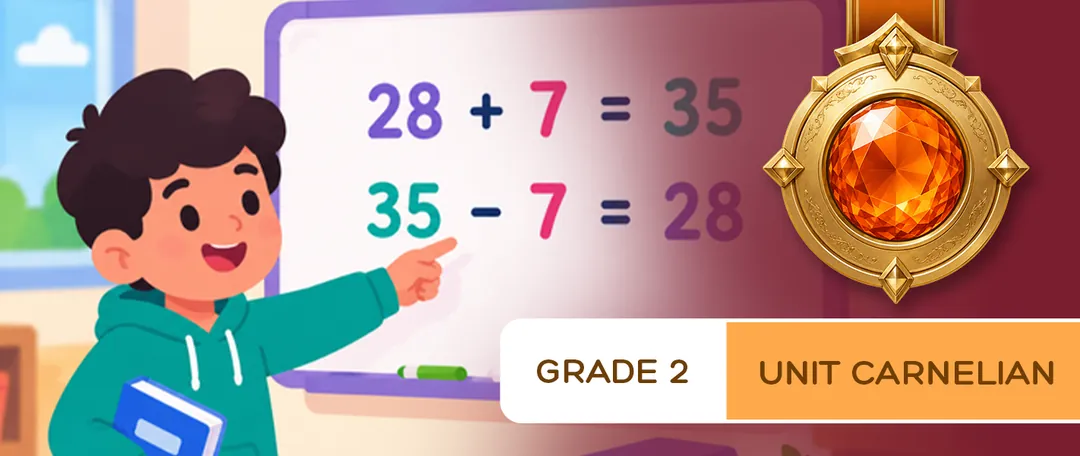
Illustrate subtraction of 2-digit by 1-digit on the number line and as an inverse of addition.
Subtract numbers where both numbers are less than 100 with regrouping: 2-digit minus 1-digit numbers; 2-digit minus 2-digit numbers.
Solve problems, given orally or in pictures, involving subtraction where both numbers are less than 100, with and without regrouping.
Subtract numbers, where both numbers are less than 1,000, with and without regrouping.
Solve 1- and 2-step problems involving subtraction where both numbers are less than 1,000, including problems involving money, with and without regrouping.
Patterns
2 competencies
Determine the next term/s in increasing or decreasing patterns, such as numbers, letters, rhythmic properties, visual elements in arts, and repetitions.
Create increasing or decreasing patterns.
Data and Pictographs
2 competencies
Present raw data, or data in tabular form, in a pictograph with a scale, or vice versa.
Interpret data in tabular form and in a pictograph with or without a scale.
Multiplication and Equal Groups
4 competencies
Count the number of concrete objects in a group by repeated addition and create equal groups, using language such as “5 groups of 3” and “5 threes.”
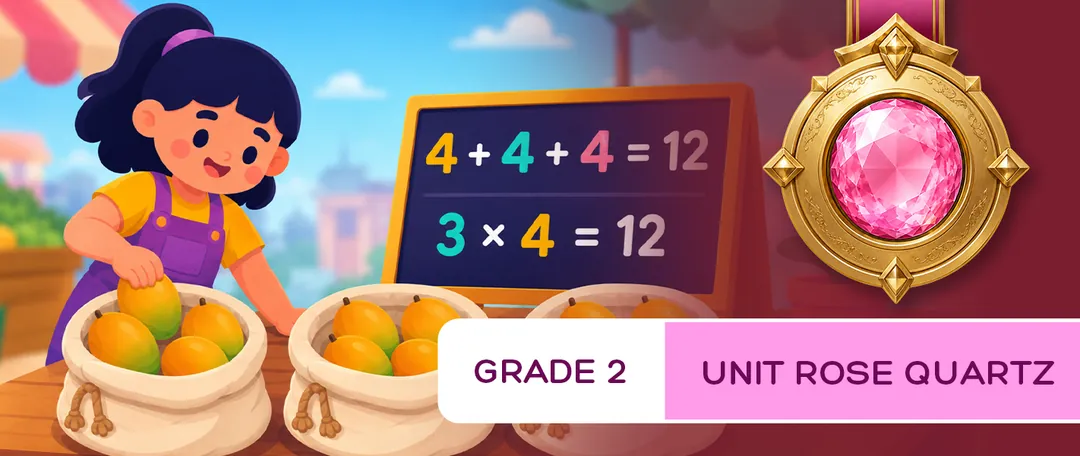
Illustrate and write multiplication as repeated addition, using a variety of concrete and pictorial models and numerals, and using groups of equal quantities, arrays, counting by multiples, and equal jumps on a number line.
Multiply numbers using the 2, 3, 4, 5, and 10 multiplication tables.
Solve multiplication problems using the 2, 3, 4, 5, and 10 multiplication tables, including problems involving money.
Division and Equal Sharing
6 competencies
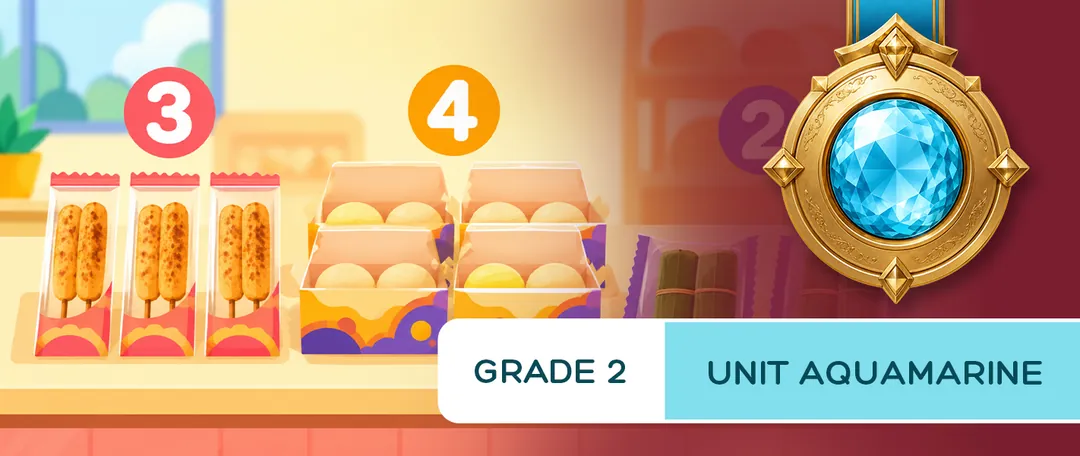
Illustrate division through equal distribution of a number of objects into several groups.
Illustrate and write division expressions using concrete and pictorial models and numerals, in modelling division as equal sharing or formation of equal groups of objects and repeated subtraction.
Divide numbers using the 2, 3, 4, 5, and 10 multiplication tables.
Find the missing number in a number sentence involving multiplication or division by 2, 3, 4, 5, and 10.
Distinguish even and odd numbers using division by 2.
Solve division problems using the 2, 3, 4, 5, and 10 multiplication tables, including problems involving money.
Fractions
6 competencies
Represent and identify unit fractions with denominators 2, 3, 4, 5, 6, and 8.
Read and write unit fractions in fraction notation.
Order unit fractions from smallest to largest, and vice versa.
Represent and identify similar fractions with denominators 2, 3, 4, 5, 6, and 8 using groups of objects, fraction charts, fraction tiles, and the number line.
Read and write similar fractions in fraction notation.
Order similar fractions from smallest to largest, and vice versa.
Time and Calendar
3 competencies
Describe the duration of an event in terms of number of days and/or weeks using a calendar.
Read and write time in hours and minutes, with a.m. and p.m., using an analog clock.
Solve problems involving elapsed time, including minutes in an hour, hours in a day, days in a week, and timetables.
Perimeter
3 competencies
Identify and measure the perimeter of a plane figure using appropriate tools.
Find the perimeter of triangles, squares, and rectangles.
Solve problems involving the perimeter of triangles, squares, and rectangles.